Bikrighor: A Multi-Tenant Ecommerce SaaS Built for Bangladesh
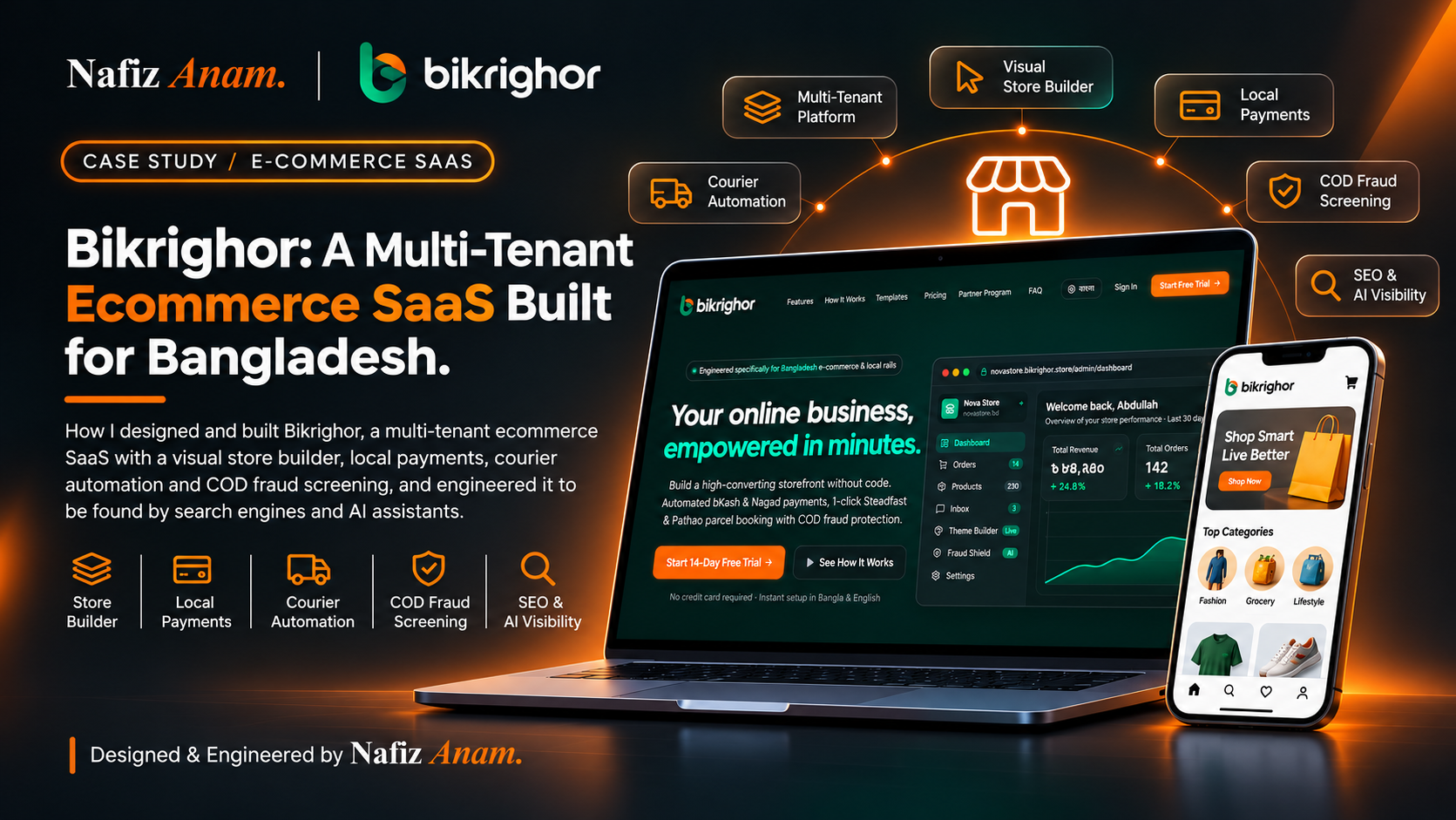
How I designed and built Bikrighor, a multi-tenant ecommerce SaaS with a visual store builder, local payments, courier automation and COD fraud screening, and engineered it to be found by search engines and AI assistants.
Services provided: SaaS, Ecommerce, Multi-tenant, Go, Next.js, PostgreSQL, SEO, AEO, GEO
Client
Bikrighor (own product)
My Role
Lead Full-Stack Engineer & Solutions Architect
Key Outcome
Live multi-tenant SaaS with 0% sales commission, local payments and courier automation
Short answer: what is Bikrighor?
Bikrighor (bikrighor.com) is a multi-tenant ecommerce SaaS I designed and built end to end for Bangladeshi merchants. A merchant signs up, picks a storefront template, customizes it in a drag-and-drop block builder, connects local payments (bKash, Nagad, Rocket, SSLCommerz) and couriers (Pathao, Steadfast, RedX), and goes live with 0% sales commission. Flat BDT subscription plans start at ৳999/month with a 14-day free trial.
This case study covers the problem, the architecture, the hard engineering decisions, and how the product was built to be found by search engines, answer engines and AI assistants from day one.
Project snapshot
| Product | Bikrighor, online store builder for Bangladesh |
|---|---|
| Live site | bikrighor.com |
| My role | Lead Full-Stack Engineer & Solutions Architect |
| Model | Multi-tenant SaaS: storefront, landing pages, merchant dashboard, branded mobile app |
| Build window | First commit July 2026, production deploys running by autumn 2026 |
| Scale of the codebase | 19 backend domain modules, 280+ database migrations, 80,000+ lines of Go, 100,000+ lines of TypeScript |
| Stack | Go, PostgreSQL 16 (row-level security), Redis, Meilisearch, Next.js, Tailwind, Expo, Cloudflare R2, Docker |
What problem does Bikrighor solve?
Most Bangladeshi small businesses still sell through Facebook pages and WhatsApp. That works until volume grows, and then the same four problems appear:
- Cash on delivery fraud. Fake and returned COD orders eat margin. Merchants book couriers blind and pay return fees.
- Manual logistics. Copy-pasting addresses into courier portals, one order at a time, across several couriers.
- Foreign platforms that do not fit. Global store builders charge in dollars, take a cut of sales, and have no bKash, Nagad or local courier support.
- No bilingual tooling. Merchants and customers move between Bangla and English; most tools handle only one.
The brief I set myself: a store builder that a boutique owner can launch in minutes, priced in taka, with local payments, couriers and fraud screening built in rather than bolted on.
What did I build?
Visual block-based store builder
Merchants assemble pages from a registry of 30 block definitions (layout, content, commerce, marketing). Pages, themes and templates are described by shared Zod schemas, then rendered by one renderer package, so the editor preview and the live storefront are the same code path. Five production templates ship today, from a general starter to grocery, electronics and modest fashion.
Commerce loop built for local reality
- Payments: bKash, Nagad, Rocket, SSLCommerz, EPS, Upay and Stripe, plus cash on delivery.
- Couriers: Steadfast, Pathao, RedX, Paperfly and Carrybee with one-click booking and automatic routing between couriers.
- COD fraud screening: orders are scored before dispatch using courier and district history.
- Inventory: one stock count synced across website, Facebook/Instagram shop and POS.
- Messaging: WhatsApp order confirmations and cart recovery, SMS, and email.
AI features
An AI catalog generator drafts product titles and descriptions in Bangla and English. A bilingual shopping assistant for web and WhatsApp can search products and add items to the cart.
Growth and partner engine
A tiered partner program lets agencies and freelancers earn recurring commission. It includes referral attribution with a 60-day cookie, milestone cash gifts granted exactly once per tier, a payout ledger, and an admin console. A store ownership transfer flow lets an agency build a client store, hand over ownership by claim link, and stay on as a developer collaborator.
How is it architected?
Bikrighor is a pnpm and Turborepo monorepo with a Go backend and Next.js and Expo front ends.
- Go gateway with 19 domain modules (catalog, orders, billing, courier, partners, storefront, inbox, security and more) behind a Chi router, with service contracts defined for gRPC extraction later. I kept it a modular monolith first: one deployable, strict module boundaries, no premature microservices.
- PostgreSQL 16 with row-level security. Tenant isolation is enforced by the database, not only by application code. A forgotten
WHERE org_id = ?cannot leak another merchant's data. - sqlc and golang-migrate. Typed queries generated from SQL, and every schema change is a numbered migration. The repo has passed 280 of them.
- Next.js dashboard and tenant storefronts in one app, with hostname-based routing to custom domains and an SSL agent service for certificates.
- Expo mobile apps: a merchant app and a branded customer app generated per store by a build worker.
- Redis, Meilisearch, Cloudflare R2 for caching and queues, typo-tolerant product search, and media storage.
What were the hard engineering decisions?
Why enforce multi-tenancy in the database?
Application-level tenant filters fail the first time someone writes a query in a hurry. Row-level security makes isolation the default and failure loud. The cost is discipline in connection handling: every request sets the tenant context, and platform-admin paths use explicit, audited policies.
How are merchant credentials protected?
Payment and courier API keys are encrypted at rest with AES-GCM, with ciphertext bound to the organization, category and provider so a stolen row cannot be replayed under another tenant. Keys rotate through a decrypt-only previous-key list and re-encrypt lazily on read.
How does auth hold up?
Self-hosted JWT sessions with refresh-token families and session watermarks, so a leaked token can be invalidated as a group. Checkout uses OTP verification, and public forms sit behind Cloudflare Turnstile.
How do deployments stay safe?
A CI pipeline builds images and migrates a Postgres database before rolling the gateway and web containers on a VPS. One real incident shaped it: a renumbered migration left a stale file on the server and two migrations claimed version 38. The pipeline now wipes the remote migrations directory before each sync so the server always mirrors the repo.
How was Bikrighor built for SEO, AEO, GEO and AIO?
A store builder lives or dies on discoverability, both for Bikrighor itself and for every merchant storefront it generates. Search is treated as a product feature, not a launch checklist.
Classic SEO
- A central SEO library generates per-page metadata, canonical URLs and Open Graph images, so no page ships without them.
- Structured data (JSON-LD graph) for the organization, software product, offers and breadcrumbs.
robots.txtandsitemap.xmlgenerated from routes. Private, auth and checkout routes are explicitlynoindex.- Performance targets of fast CDN delivery and sub-second largest contentful paint on storefronts, because Core Web Vitals are a ranking input and a conversion input.
- Bangla and English content with a language toggle, so the product can rank for queries in both languages.
AEO: answer engine optimization
- Pages lead with a direct, quotable answer, then expand. Pricing, integrations and plan limits are stated as plain facts in plain HTML, not hidden in images or scripts.
- Question-style headings that match how merchants actually ask ("Does Bikrighor charge sales commission?", "Which couriers are supported?").
GEO and AIO: generative and AI-overview optimization
- A
llms.txtfile gives AI crawlers a clean, curated map of what the product is and where authoritative pages live. - Consistent entity naming (Bikrighor, bikrighor.com, the engineer) across schema, copy and profiles so models resolve it as one entity.
- Specific, checkable facts (taka pricing, named integrations, 64-district coverage) rather than vague superlatives, which generative engines can cite with confidence.
Measurement
The platform runs its own Google Tag Manager container with Consent Mode v2 (denied by default, banner-controlled) and a typed event layer covering the full funnel: sign up, email verified, store created, onboarding steps, product created, page published, checkout and purchase. A first-party server-side GTM endpoint and GA4 Measurement Protocol events from the backend (first order received, subscription started, payment failed, churn) capture what browsers cannot. Staff and impersonation sessions are muted so internal use never pollutes the data.
Results
- A live, multi-tenant platform at bikrighor.com, shipped by one engineer in roughly four months of building.
- The complete merchant loop works end to end: catalog, cart, checkout, local payment, courier booking, fulfilment and billing.
- A partner channel and an agency handover flow that make distribution part of the product.
- Search, answer-engine and AI-crawler discoverability built into the platform instead of retrofitted.
Merchant-outcome figures shown on the Bikrighor site (conversion lifts, fake-order catch rate, return-loss savings) are the product's own published claims; I do not restate them here as independently audited results.
Frequently asked questions
Does Bikrighor charge a commission on sales?
No. Bikrighor charges a flat monthly or yearly subscription in BDT (Starter ৳999, Growth ৳1,999, Scale ৳3,999 per month) and takes 0% of merchant sales.
Which payment methods and couriers does it support?
Payments: bKash, Nagad, Rocket, SSLCommerz, EPS, Upay, Stripe and cash on delivery. Couriers: Steadfast, Pathao, RedX, Paperfly and Carrybee.
What tech stack is Bikrighor built on?
A Go backend, PostgreSQL 16 with row-level security, Redis, Meilisearch, Next.js with Tailwind for the dashboard and storefronts, Expo for mobile, and Cloudflare R2 for media, deployed with Docker.
Can I hire the person who built it?
Yes. I build SaaS products, ecommerce platforms and tracking and analytics systems for founders and teams. Book a call to talk through your product.
More case studies
Start a Project
Planning something similar?
Let's talk about your goals and how we can turn them into a scalable, production-ready system.