When to Hire a Contractor vs. an Agency vs. a Full-Time Engineer
Each path solves a different problem. Picking the wrong one for your stage is one of the most expensive mistakes founders make.
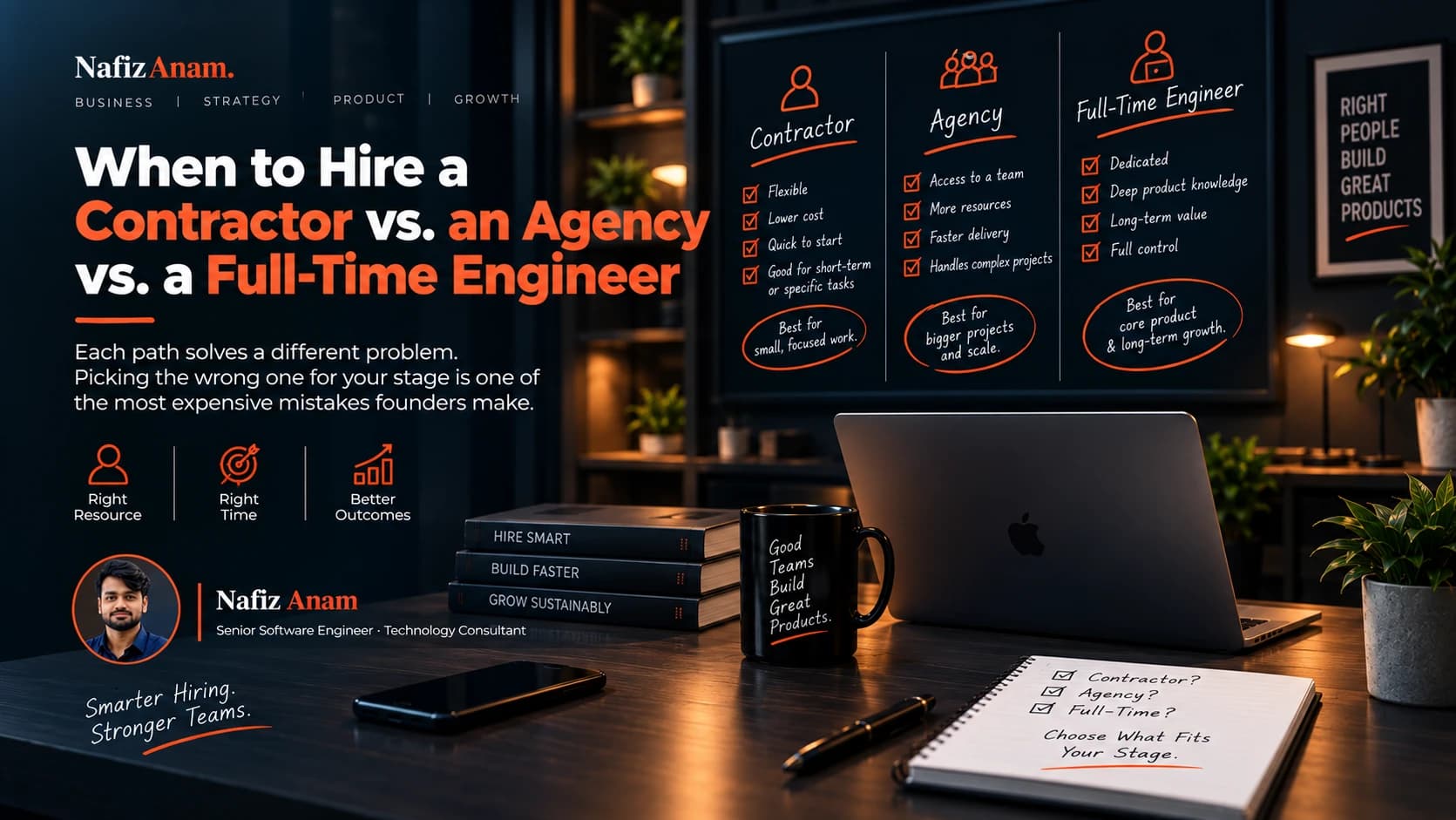
One of the most expensive mistakes founders make isn't choosing a bad contractor, a bad agency, or a bad engineer — it's choosing the wrong category entirely for where their company actually is. Each path solves a genuinely different problem, and they're not interchangeable just because all three can technically write code. Picking the wrong one doesn't just waste budget; it often sets the wrong expectations for months before anyone realizes the mismatch.
Here's how I think about the decision, based on what each option is actually built to deliver — not just what it costs.
Contractor: Best for a Scoped, Well-Defined Build
A contractor is the right fit when you already know what you want built, roughly how it should work, and what "done" looks like. You're not buying ongoing product judgment or strategic direction — you're buying focused execution against a scope that's already been thought through, ideally in a proper discovery process before the contract starts.
This works well for: a specific feature with a clear spec, a well-defined integration, an MVP where the founder already has strong product opinions, or a short, time-boxed engagement with a known end state. It works poorly when the scope itself is still fuzzy, because a contractor engaged to execute a plan isn't typically the right person to also be defining that plan from scratch — that's a different (and usually more expensive) kind of engagement.
The economics of a contractor are straightforward: you pay for the hours or the scoped deliverable, and the relationship can end cleanly when the work is done. There's no ongoing payroll, no benefits, no ramp-up cost for a role you might not need again for six months.
Agency: Best When You Need a Full Team Fast, Without In-House Technical Leadership
An agency makes sense when the project needs more than one skill set at once — design, frontend, backend, maybe DevOps — and you don't have a technical leader in-house who can hire, direct, and evaluate individual contractors to assemble that team yourself. You're essentially renting both the team and the management layer that coordinates it.
This is the right call for founders without a technical co-founder who need a production-ready product built end-to-end, or for companies that need to move fast on something outside their core technical competency and don't want to spend months building an internal team to do it. The trade-off is cost — you're paying for project management and coordination overhead on top of the engineering itself — and sometimes less direct visibility into who's actually doing the work day to day.
Where agencies go wrong for clients is the same place contractors do, just at higher stakes: engaging one before the problem and scope are genuinely well understood. An agency executing confidently against an unclear brief will still produce something — it just might not be the right something, and the cost of that mismatch scales with the size of the team building it.
Full-Time Engineer: Best Once Institutional Knowledge Starts Compounding
A full-time hire makes the most sense once your product direction is stable enough that accumulated context — how the system works, why past decisions were made, what's been tried and didn't work — becomes genuinely valuable over time rather than a one-off cost. Full-time engineers are an investment in continuity, not just output. Their value compounds the longer they stay, because they stop needing things re-explained and start anticipating problems before they happen.
This is the right call once you have ongoing, not episodic, engineering needs — a product that needs continuous iteration, a system that needs someone who deeply understands its quirks on call, or a team that's grown enough that coordination and mentorship matter as much as raw output. It's the wrong call for a six-week project, because you're paying for months of ramp-up and the overhead of hiring, onboarding, benefits, and management for value that mostly accrues after the relationship has had time to mature.
The Mistake Most Early-Stage Founders Make
In practice, the most common and most expensive mistake is defaulting to "we need a full-time hire" when what the situation actually calls for is a contractor for eight weeks. This usually comes from an understandable instinct — hiring feels like the "serious" move, the one that signals commitment and stability. But a full-time engineering hire is a six-figure-a-year, multi-month-to-reverse decision, and making that decision to solve a problem that's actually scoped and bounded is expensive overkill.
The reverse mistake also happens, usually later: a company keeps stitching together contractors for a system that has become core, ongoing infrastructure, because nobody wants to go through the hiring process. At that point, the lack of institutional continuity — different contractors re-learning the system every few months — starts costing more than a full-time hire's salary would.
If the real question underneath this decision is specifically "do we need a CTO," I've written a more focused breakdown of when a full-time CTO hire actually makes sense versus fractional leadership.
A Simple Way to Decide
Ask three questions. Is the scope well-defined and time-bounded, or genuinely ongoing? Do you have in-house technical leadership to direct individual contributors, or do you need the coordination layer included? And is the value here mostly about getting this specific thing built, or about someone accumulating deep, compounding knowledge of a system that will keep evolving? The honest answers to these three questions point to one of the three paths far more reliably than gut instinct or what feels like the "proper" way to staff a project.
Frequently Asked Questions
Can a contractor turn into a full-time hire later?
Yes, and it's often a good path — you get to evaluate working style and output on a real project before making a longer-term commitment. Just be clear upfront about whether that's a possibility, so expectations on both sides are set correctly.
Is an agency always more expensive than hiring contractors directly?
Usually, per hour of engineering work, yes — you're paying for coordination overhead. But if you don't have the in-house technical leadership to manage contractors yourself, that overhead is buying something real: the risk of a mismanaged, uncoordinated team is often more expensive than the agency premium.
What's the risk of using a contractor for something that's actually ongoing?
You lose continuity. Each new contractor has to re-learn the system, and institutional knowledge about why things were built a certain way tends to walk out the door when the contract ends. For genuinely ongoing, evolving systems, that re-learning cost adds up fast.
Deciding How to Staff Your Next Project?
If you're trying to figure out whether your situation calls for a contractor, an agency, or a full-time hire, I help founders think through exactly this before committing budget to the wrong one. Explore my Engineering Leadership and Technical Consulting & Architecture services, or see the full list on my services page.
Work Together
Facing something similar in your product?
I help founders and technical teams design, build, and scale software products the right way. Let's talk about your specific challenges.