ISP Nova: Billing and Network Management SaaS for Bangladeshi ISPs
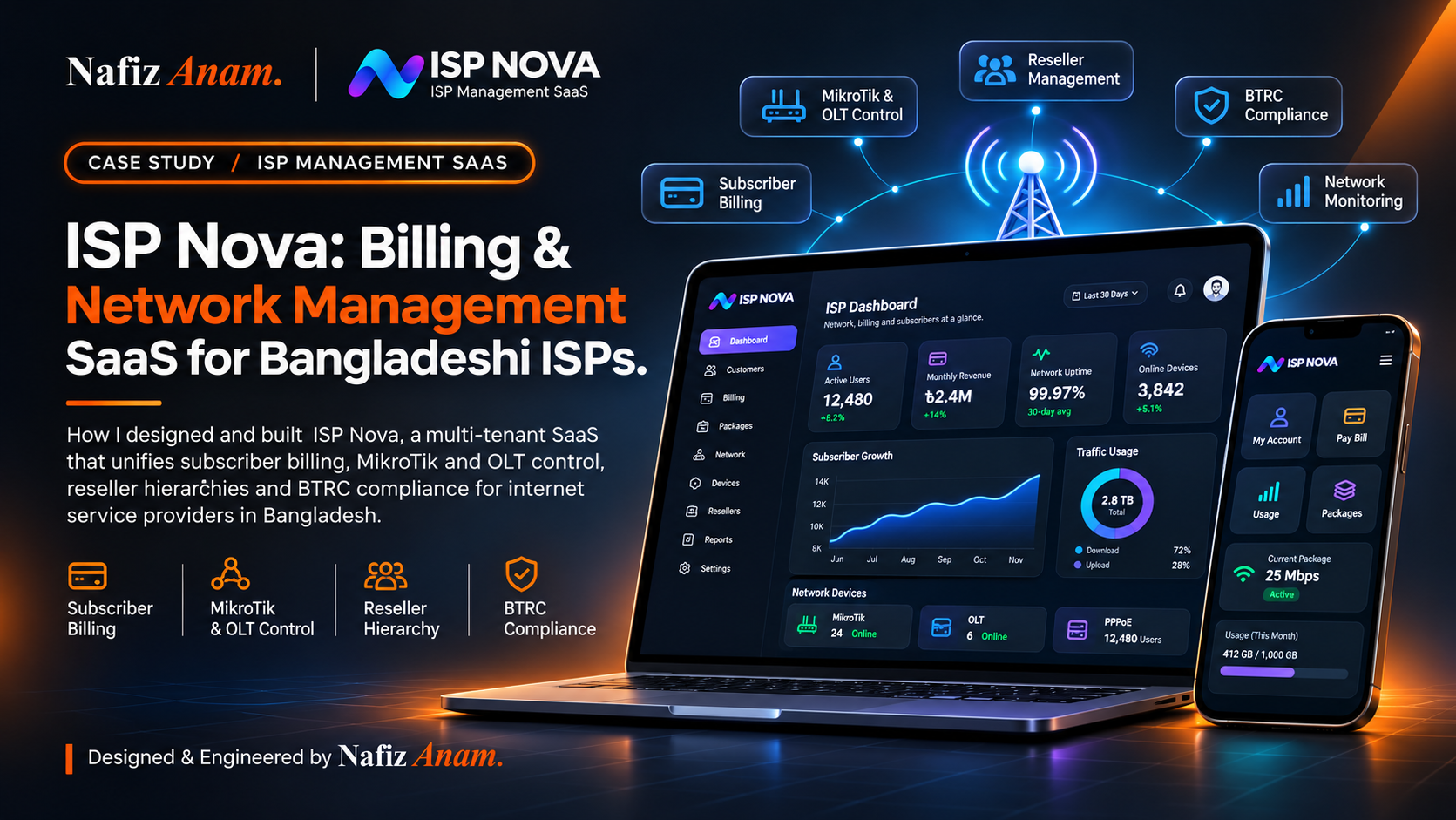
How I designed and built ISP Nova, a multi-tenant SaaS that unifies subscriber billing, MikroTik and OLT control, reseller hierarchies and BTRC compliance for internet service providers in Bangladesh.
Services provided: SaaS, ISP, Billing, MikroTik, Multi-tenant, Node.js, PostgreSQL, BullMQ, SEO, AEO
Client
ISP Nova (own product)
My Role
Lead Full-Stack Engineer & Solutions Architect
Key Outcome
Multi-tenant ISP platform with automated billing, network control and four portals
Short answer: what is ISP Nova?
ISP Nova (ispnova.cloud) is a multi-tenant SaaS I designed and built to run an internet service provider in Bangladesh. One platform handles subscriber management, automated billing, MikroTik and OLT network control, reseller hierarchies, support ticketing and BTRC compliance. ISPs sign up on flat BDT plans starting at ৳799/month with a 14-day free trial.
This case study covers the problem, the architecture, the hard engineering decisions, and how the product was set up to be found by search engines, answer engines and AI assistants.
Project snapshot
| Product | ISP Nova, ISP management and billing software for Bangladesh |
|---|---|
| Live site | ispnova.cloud |
| My role | Lead Full-Stack Engineer & Solutions Architect |
| Model | Multi-tenant SaaS with four portals: platform admin, ISP admin, reseller and customer |
| Build window | First commit April 2026, actively shipping through November 2026 |
| Scale of the codebase | 120+ data models, 70+ backend services, 130,000+ lines of TypeScript across server, web and two mobile apps |
| Stack | Node.js, Express, Prisma, PostgreSQL, Redis, BullMQ, Socket.IO, Next.js, Expo, Docker, Prometheus, Grafana and Loki |
What problem does ISP Nova solve?
A typical Bangladeshi ISP starts as one operator with a MikroTik router and a spreadsheet. By a few hundred subscribers, the spreadsheet is the bottleneck:
- Billing leaks revenue. Due dates are tracked by hand, reminders go out late, and expired customers stay connected or get cut off by mistake.
- Network and billing are separate worlds. Suspending a non-paying subscriber means logging into the router by hand.
- Reseller chains are opaque. Many ISPs sell through area agents and sub-agents, and tracking balances and commissions across that tree is error-prone.
- Compliance is manual. BTRC reporting and subscriber records are rebuilt from scratch each time.
- Foreign tools do not fit. Few support bKash, Nagad, local SMS, OLT/GPON gear and BDT pricing in one place.
The brief: one system where a payment, a connection state and a customer record never drift apart, usable by a five-person ISP or a multi-zone operator.
What did I build?
Four portals on one platform
- Platform admin: onboard and manage ISPs, define subscription plans and quotas, view invoices, announcements, audit logs, system health and support-session impersonation.
- ISP admin: dashboard, customers, connection requests, zones, packages, invoices, expenses, tickets, network devices and reports, with role-based permissions for owners, managers and staff.
- Reseller portal: master, area and sub-reseller hierarchy with balances, commission rates and payout requests.
- Customer portal and app: view and pay invoices, raise tickets, check connection status.
Billing automation
A scheduler detects due dates, generates invoices, sends SMS, WhatsApp and email notices, collects payment through bKash and Nagad, and renews or suspends service automatically. Partial payments, overdue states, expenses and a double-entry ledger are supported on higher plans.
Network control
Native integration with MikroTik (PPPoE and hotspot), RADIUS, SNMP and LDAP, plus OLT/GPON management for Huawei and ZTE gear. Router health, live bandwidth and topology are monitored, and a captive-portal flow redirects expired customers to a pay-now page.
Business operations beyond billing
Hotspot voucher sales, inventory and purchase orders, HRM with attendance, leave and payroll, KYC records, and revenue analytics covering MRR, churn and ARPU.
Mobile apps
An Expo customer app that can be white-labeled per ISP tenant (each tenant gets its own branding config), and a separate Expo staff app for field teams, with push notifications.
How is it architected?
- Express and TypeScript API with Zod validation on every input, layered as routes, controllers and services. Business rules live in services so the same logic serves the web app, mobile apps and background jobs.
- PostgreSQL with Prisma and a migration history, modelling organizations, subscriptions, customers, invoices, ledgers, resellers, devices and compliance records.
- BullMQ on Redis for scheduled billing, notifications, bulk messaging and device polling, so slow router or SMS calls never block a request. A queue dashboard gives operators visibility.
- Socket.IO for live device status and bandwidth.
- Next.js front end for the four portals, and a separate Next.js marketing site with English and Bangla message catalogs.
- Observability: Prometheus, Grafana, Loki and Alertmanager run beside the app, so an ISP outage is something I see before the customer calls.
- A shared Bangladesh locations API for divisions, districts and upazilas used in addresses and zones.
What were the hard engineering decisions?
How do you keep billing and the network in sync?
The invoice state is the source of truth. A payment webhook marks the invoice paid, which enqueues a job that re-enables the subscriber on the router. If the router is unreachable, the job retries with backoff and the mismatch is surfaced in the dashboard instead of silently lost. Suspension runs the same path in reverse.
How is tenant data isolated?
Every domain record carries an organization id, and every query is scoped through a shared resolver rather than hand-written filters in each controller. Platform-admin impersonation is a first-class, time-boxed, audit-logged session, never a shared password.
How is SaaS billing handled?
ISP Nova's own subscription billing runs through AgiloPay, a payment engine I built separately, which abstracts bKash, Nagad, Rocket, SSLCommerz, EPS and Paddle behind one API. I deleted the legacy per-gateway adapters during the cutover, so there is a single payment path to secure and test.
How are secrets and abuse handled?
Sensitive fields such as device credentials are encrypted at rest. Auth has progressive rate limiting, password policy enforcement, optional OTP and phone login, IP allowlisting for platform routes, and security event logging. Admin actions land in a tamper-evident audit log for compliance.
How was ISP Nova built for SEO, AEO, GEO and AIO?
ISP software is bought after research: owners search for comparisons, pricing and "does it work with MikroTik and bKash". The marketing site is built to win those moments.
Classic SEO
- A standalone Next.js marketing site, separate from the app, so it can be statically rendered, fast and crawlable.
- English and Bangla message catalogs, so the site can rank for queries in both languages.
- Clear page titles such as "ISP Management Software Bangladesh", with pricing, features and integrations in indexable text rather than screenshots.
AEO: answer engine optimization
- Pricing, plan limits (customers, routers, staff) and integrations are stated as plain facts, so answer engines can quote them directly.
- Question-led headings matching real searches, such as "Does it support MikroTik?" and "Is it BTRC compliant?".
- An in-app Help Center and knowledge base of task-oriented articles that doubles as source material for assistants.
GEO and AIO: generative and AI-overview optimization
- Consistent entity naming (ISP Nova, ISPnova, ispnova.cloud, built by Agilo) across copy, metadata and profiles, so models resolve one product.
- Specific, citable facts: named hardware (MikroTik, Huawei and ZTE OLT), named payment methods, BDT prices and quotas.
- Clear separation between the product and its parent company, which avoids entity confusion in AI answers.
Results
- A working multi-tenant platform covering the full ISP lifecycle, from connection request to billing, network control, reseller payouts and support.
- Four web portals plus two mobile apps, built and shipped by one engineer in about seven months.
- A single, hardened payment path through AgiloPay, replacing six separate gateway adapters.
- Monitoring, queues and audit trails in place, so the system can be operated, not just demoed.
Adoption and savings figures on the ISP Nova site (ISPs onboarded, hours saved, compliance claims) are the product's own marketing claims, and dashboard numbers on the site are illustrative sample data. I do not restate them here as audited results.
Frequently asked questions
What does ISP Nova cost?
Starter is ৳799/month (up to 300 customers, 2 routers, 3 staff), Business is ৳1,699/month (up to 2,000 customers, 10 routers, 10 staff), and Enterprise is ৳3,499/month (unlimited, plus OLT/GPON, ledger, API keys and white-label branding). All plans include a 14-day free trial.
Does it work with MikroTik and local payments?
Yes. It integrates with MikroTik, RADIUS and SNMP for network control, and supports bKash and Nagad for subscriber payments.
What tech stack is ISP Nova built on?
Node.js, Express and TypeScript with Prisma and PostgreSQL, Redis and BullMQ for background jobs, Next.js for the portals, Expo for mobile, and Docker with Prometheus and Grafana for operations.
Can I hire the person who built it?
Yes. I build SaaS products, billing and payment systems, and network-connected platforms. Book a call to talk through your product.
Start a Project
Planning something similar?
Let's talk about your goals and how we can turn them into a scalable, production-ready system.