Servero: Managed Server-Side GTM Hosting SaaS
How I designed and built Servero, a multi-tenant SaaS that hosts isolated server-side Google Tag Manager containers on first-party domains, with data-recovery power-ups, usage billing and built-in SEO.
Services provided: SaaS, Server-side GTM, Tracking, Analytics, Docker, Node.js, PostgreSQL, Next.js, SEO, AEO
Client
Servero (own product)
My Role
Lead Full-Stack & DevOps Engineer
Key Outcome
Live managed sGTM platform with per-tenant containers, first-party domains and usage-based billing
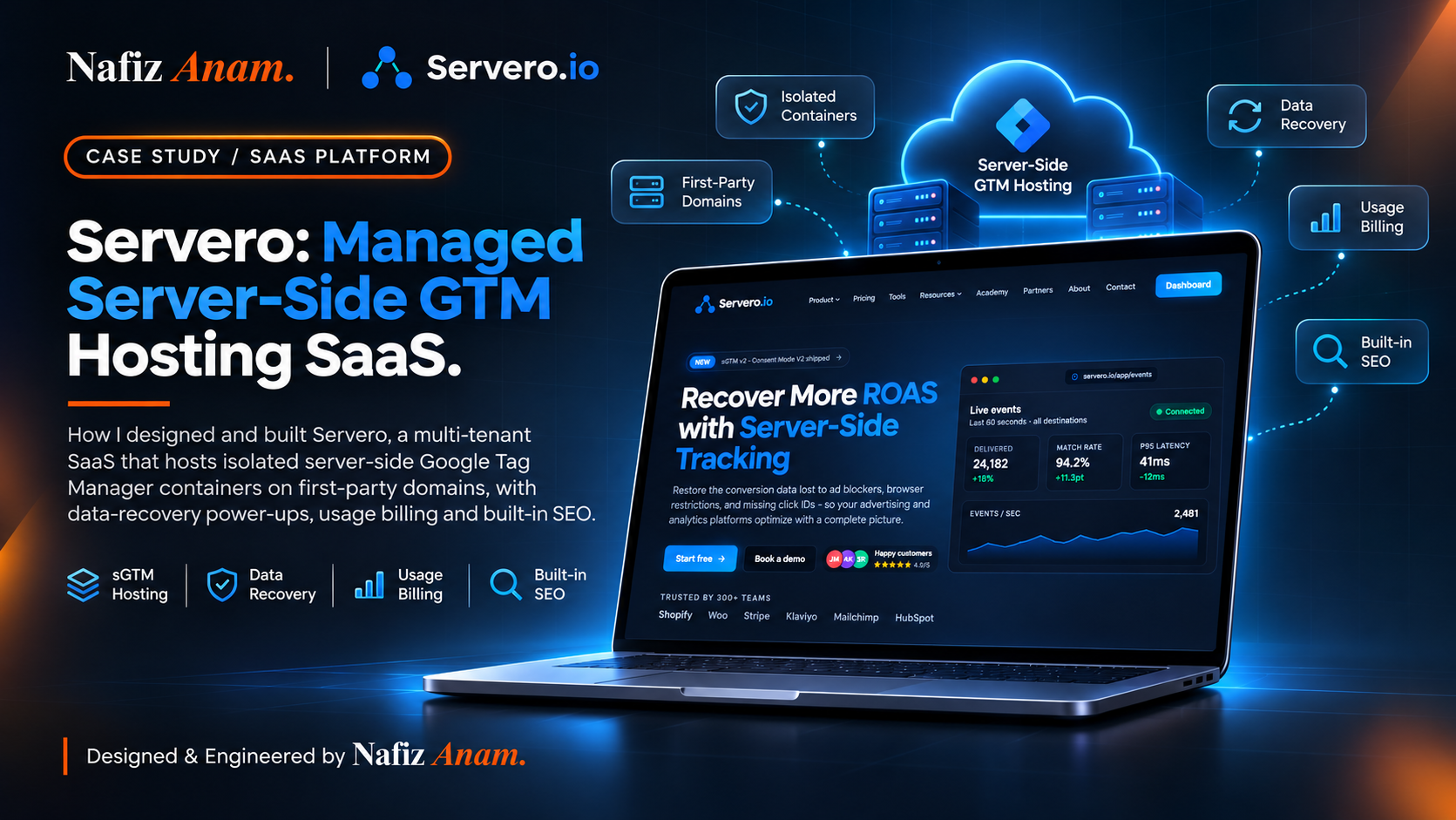
Short answer: what is Servero?
Servero (servero.io) is a managed server-side Google Tag Manager (sGTM) hosting platform that I designed and built. A customer connects their domain with one DNS record, Servero provisions an isolated sGTM container on a first-party subdomain such as track.yourstore.com, and conversion events are routed server-side to Meta, Google, TikTok and other ad platforms. The goal is to recover conversion data lost to ad blockers, Safari cookie limits and stripped click IDs. Plans run from a free tier to custom volume, priced in USD or BDT.
This case study covers the problem, the architecture, the hard engineering decisions, and how the product was set up to be found by search engines, answer engines and AI assistants.
Project snapshot
| Product | Servero, managed server-side GTM hosting |
|---|---|
| Live site | servero.io |
| My role | Lead Full-Stack & DevOps Engineer |
| Model | Multi-tenant SaaS that runs one isolated sGTM container per customer |
| Build window | First commit January 2026, with the white-label core backend following in May 2026 and shipping continuously since |
| Scale of the codebase | 85+ data models, 130+ database migrations, 190,000+ lines of TypeScript across the backend, dashboard app, marketing site and SSL agent |
| Stack | Node.js, Express, Prisma, PostgreSQL 16, Redis, BullMQ, Dockerode, Next.js 15, nginx, certbot, Docker |
What problem does Servero solve?
Browser-side tracking is leaking. Ad blockers, Safari's Intelligent Tracking Prevention, shorter cookie lifetimes and click IDs stripped from URLs mean ad platforms see only part of the conversions they drive. Their optimization then runs on incomplete data and ad spend is wasted.
Server-side tagging is the standard fix, but self-hosting an sGTM container means standing up cloud infrastructure, wiring a custom domain and SSL, and watching it for failures. Existing hosted options either charge heavily at volume or leave out the modules that actually recover data. The brief I set for Servero:
- Fifteen minutes to first-party tracking for a store owner who has never touched a server.
- Data recovery built in, not sold as add-ons: longer-lived cookies, click ID restoration and consent handling.
- Fair, predictable pricing by monthly request volume, including local currency billing for South Asian customers.
- Agency-friendly operation, with many client containers under one account.
What did I build?
Managed sGTM containers on the customer's own subdomain
The customer adds a CNAME. An SSL agent issues and renews certificates, a load balancer routes traffic, and the backend provisions an isolated Google Tag Manager server container for that tenant. Because the tracking endpoint lives on the customer's own domain, it is first-party and far harder for blockers to cut off.
Power-ups that recover and protect data
- Cookie Keeper: extends identity cookie life from 7 days to 365 days.
- Click ID Restorer: recovers fbclid, gclid, msclkid and ttclid across sessions when they are stripped from the URL.
- Consent Mode v2: consent-aware tracking with geography-based defaults.
- Custom Loader: serves the tag script from the first-party domain to avoid script blocking.
- Quality and safety: bot detection, IP and country blocklists, user-agent and geo headers, PII anonymization, and an XML-to-JSON transformer.
- Operations: multi-domain containers, multi-container accounts, dedicated IP, request scheduling and delay, and a file proxy.
Destinations and integrations
Guides and templates for Meta Conversions API, Google Analytics 4, Google Ads, TikTok Events, LinkedIn, Snapchat and more, plus a custom GA4 deduplication client written as a GTM template. CRM integrations and inbound webhooks feed offline and lead events back in.
Observability for customers
A live event stream, per-destination delivery status, request-volume meters and a tracking health-check browser extension help customers prove that events are arriving and being accepted, which is the first question every server-side setup gets.
Business layer
Plans by monthly request volume, billing through Paddle for international customers and a local gateway for Bangladesh, coupons, an affiliate programme with levels, an academy for courses, agency handover and client pay links, a marketplace, support tickets and a full admin console.
How is it architected?
Servero is split into small deployable pieces that share a white-label core.
- White-label core backend: Express, TypeScript and Prisma on PostgreSQL 16. All brand strings come from environment variables, so the same codebase can run under another brand without edits.
- Container orchestration with Dockerode: the backend provisions, monitors, restarts and retires per-tenant sGTM containers, with health monitors, idle-container jobs and config-drift checks.
- Redis and BullMQ run the background work: usage rollups, retention, token expiry, audience sync, reconciliation, alerts and grace-period notices.
- Next.js 15 apps: a marketing website for servero.io and a separate dashboard application.
- nginx edge and an SSL agent handle custom-domain routing and certificate lifecycle on the VPS fleet.
- Disaster and rollback runbooks sit next to the code, because a tracking pipeline that is down loses revenue data that cannot be replayed.
What were the hard engineering decisions?
How do you isolate tenants running arbitrary tracking logic?
Each customer gets their own container rather than sharing a multi-tenant GTM process. A misconfigured tag from one customer cannot slow or leak into another. The cost is orchestration complexity, which I handled with a container service that treats desired state as the source of truth and reconciles against what is actually running.
How do you keep a tracking endpoint reliable?
Circuit breakers protect upstream destinations so one slow ad platform does not stall the pipeline. Failed deliveries can be replayed, and a request-delay option and event log retention jobs keep storage and latency predictable. Health checks look at the container, the domain and the custom loader separately, so an alert names the real fault.
How do you meter and bill fairly?
Billing is by monthly request count, so the metering has to be exact. I built a period counter with a documented design, a grace period before enforcement, and expiry notifications, so customers are warned before anything is throttled. Payments run through Paddle and a local gateway, with a reconciliation job to catch mismatches.
How are customer credentials and tokens protected?
Platform API tokens, integration tokens and OAuth connections are stored encrypted and scoped, with token-expiry jobs and an admin audit log. Auth uses JWT with optional TOTP two-factor, and sensitive admin actions require extra authorization.
How was Servero built for SEO, AEO, GEO and AIO?
Server-side tracking is a research-heavy purchase: people search for how to fix lost conversions, for Meta CAPI setup guides, and for comparisons with other hosts. Content is part of the product.
Classic SEO
- A dedicated Next.js 15 marketing site with feature pages, pricing, comparison pages, a changelog, a blog and free tools, each with its own metadata.
- A programmatic integrations section, with one page per destination, targeting long-tail searches such as "Meta CAPI server-side setup".
- Generated
robots.txtand sitemap, with the app dashboard on a separate subdomain so marketing pages stay fast and crawlable.
AEO: answer engine optimization
- FAQ and product structured data (JSON-LD) components reused across pages, so questions and answers are machine-readable.
- Pricing, request limits and module lists are stated as plain facts, ready to be quoted.
- A knowledge base of power-up and integration guides written as direct answers to setup questions.
GEO and AIO: generative and AI-overview optimization
- Consistent entity naming for Servero, servero.io and sGTM hosting across schema, copy and docs, so models treat it as one product.
- Specific, citable claims instead of vague superlatives: named platforms, named click IDs and exact cookie lifetimes.
- Free interactive tools with schema markup, which earn links and citations that a pure feature page does not.
Results
- A live managed sGTM hosting product with a free tier, five paid tiers and custom enterprise volume.
- Per-tenant container provisioning with first-party domains and automated SSL, so setup takes a DNS record rather than a DevOps project.
- More than twenty power-ups and integration guides covering data recovery, consent, filtering and delivery.
- Billing, affiliate, agency and admin tooling that let the product operate as a business, built by one engineer.
Figures shown on the Servero site, such as customer counts, match-rate and CPA improvements, uptime and latency, and the competitor comparison, are the product's own marketing claims. The live dashboard numbers on the site are illustrative. I do not restate them here as independently audited results.
Frequently asked questions
What does Servero cost?
There is a free plan with 20K requests a month, then paid plans at $10 (300K), $17 (600K), $35 (2M) and $75 (5M) per month, plus custom plans for 100M+ requests. Yearly billing saves 17%, and billing is available in USD or BDT.
How does server-side tracking recover lost conversions?
Events are sent to a container on your own subdomain and forwarded to ad platforms from the server. That avoids many ad-blocker rules and browser cookie limits, and tools such as Cookie Keeper and Click ID Restorer preserve identifiers that browsers would otherwise drop.
What tech stack is Servero built on?
A Node.js, Express and Prisma backend on PostgreSQL 16 with Redis and BullMQ, Docker orchestration through Dockerode for per-tenant sGTM containers, Next.js 15 for the website and dashboard, and nginx with an SSL agent for custom domains.
Can I hire the person who built it?
Yes. I build SaaS products, tracking and analytics systems, and server-side tagging setups. Book a call to talk through your project.
Start a Project
Planning something similar?
Let's talk about your goals and how we can turn them into a scalable, production-ready system.