Ponnokhata: A Cloud POS and Business Management SaaS for Bangladesh
How I designed and built Ponnokhata, a multi-branch cloud POS SaaS that unifies the till, inventory, loyalty, HR, accounting, courier booking and a WhatsApp, Messenger and Instagram inbox for Bangladeshi shops.
Services provided: SaaS, POS, Retail, Inventory, Multi-tenant, Node.js, PostgreSQL, Next.js, SEO, AEO
Client
Ponnokhata (own product)
My Role
Lead Full-Stack Engineer & Solutions Architect
Key Outcome
Multi-branch POS SaaS with a till, kiosk, mobile app, unified inbox and plan-gated billing
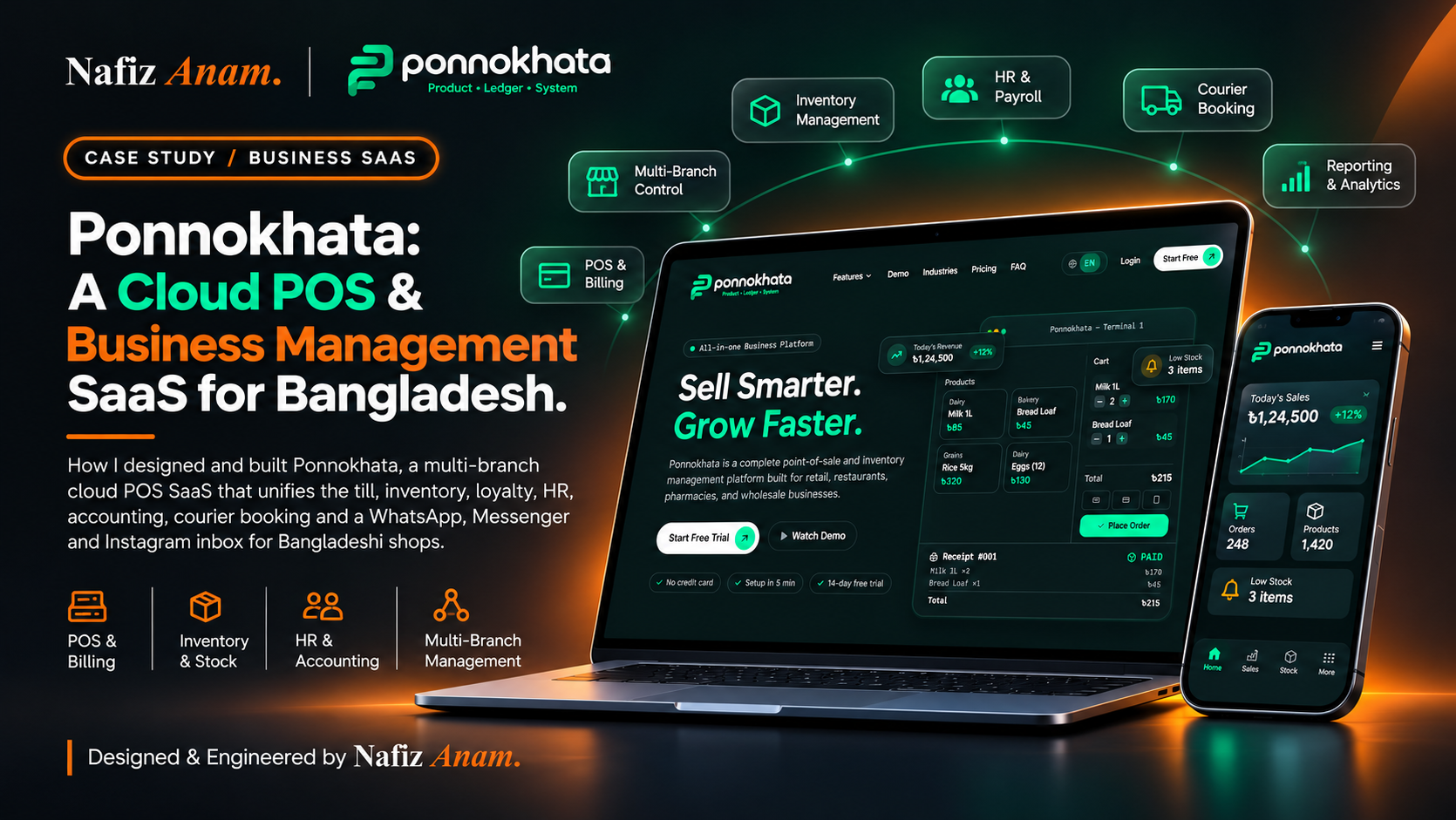
Short answer: what is Ponnokhata?
Ponnokhata (ponnokhata.com) is a cloud point-of-sale and business management SaaS that I designed and built for shops in Bangladesh. One platform covers the till, inventory, purchasing, customers and loyalty, HR and payroll, accounting, courier booking, a unified WhatsApp, Messenger and Instagram inbox, and multi-branch control, in English and Bangla. Plans start at ৳499/month with a 14-day free trial and no credit card.
This case study covers the problem, the architecture, the hard engineering decisions, and how the product was set up to be found by search engines, answer engines and AI assistants.
Project snapshot
| Product | Ponnokhata, POS and business management for Bangladesh |
|---|---|
| Live site | ponnokhata.com |
| My role | Lead Full-Stack Engineer & Solutions Architect |
| Model | Multi-tenant, multi-branch SaaS with a web back office, a till, a customer display, a self-checkout kiosk and a mobile app |
| Build window | First commit February 2026, shipping continuously through November 2026 |
| Scale of the codebase | 150 data models, 160+ front-end pages, 60+ backend services, 190,000+ lines of TypeScript |
| Stack | Node.js, Express, Prisma, PostgreSQL, Redis, BullMQ, Socket.IO, Next.js 16, React 19, Expo, Docker |
What problem does Ponnokhata solve?
A typical Bangladeshi retailer runs on a notebook, a basic billing app and a Facebook page. As the shop grows, the gaps show:
- Stock does not match the shelf. Sales, purchases and returns live in different places, so nobody trusts the numbers.
- Customer orders arrive in chat. WhatsApp, Messenger and Instagram messages are handled by hand and copied into the till.
- Delivery is manual. Couriers are booked one parcel at a time in separate portals.
- Imported tools do not fit. Few handle bKash and Nagad, Bangla receipts, local tax invoices (Mushak) and taka pricing together.
- Growth means more branches, and most small-shop software has no sane way to run several.
The brief: a POS that a cashier can learn in minutes, that keeps stock, money and customers consistent across every channel, and that scales from one counter to a chain.
What did I build?
The till and the shop floor
- Point of sale with barcode scanning, split and mixed payments, coupons, gift cards, loyalty points and receipts in English or Bangla.
- Customer-facing display and a self-checkout kiosk mode, driven in real time over Socket.IO.
- Cash register management with opening and closing reports and card payment and payout reports.
Back office
- Inventory and catalog with brands, categories, custom fields and stock tracking per branch.
- Purchasing and suppliers, purchase orders and due tracking.
- Customers and loyalty, including due reports, activity reports and reseller and wholesale pricing on higher plans.
- HR and payroll: employees, departments, attendance, leave, payroll and performance reports.
- Accounting: expenses, bank accounts, a ledger and summary reports with Excel and PDF export.
Selling beyond the counter
- Unified inbox for WhatsApp, Facebook Messenger and Instagram DMs, with canned responses.
- Courier booking with Pathao and Steadfast, plus shipping zones and parcel tracking.
- Payments: bKash and Nagad, with online payment collection.
- Meta catalog sync to publish products to Facebook and Instagram shops.
- Public API and API keys for integrations, gated by plan and enforced on every request.
Beyond Bangladesh
The platform has implementation plans and shipped phases for the UAE (VAT, Stripe) and the USA (sales tax, card receipts, payouts, accessibility and privacy controls, QuickBooks, Shippo shipping). Region-specific rules are isolated so that Bangladesh behaviour is not disturbed.
Platform and subscription layer
A platform-owner console manages tenants, plans and feature flags, announcements, a support inbox, audit logs and banned IPs. Tenants subscribe to Starter, Pro or Business plans, and branch billing adds extra branches on a per-branch basis.
How is it architected?
- Express and TypeScript API with Joi validation on every request body, strict layering of routes, controllers and services, and a consistent error type. Business logic lives in services, so web, mobile and jobs share one implementation.
- PostgreSQL with Prisma for 150 models and a long migration history covering catalog, sales, stock movements, HR, ledger, inbox and billing.
- Redis and BullMQ for billing notifications and other background work, so slow third-party calls never block the till.
- Socket.IO for the live customer display, kiosk state and inbox updates.
- Next.js 16 back office and a separate Next.js marketing website with Tailwind, Framer Motion and next-intl for English and Bangla.
- Expo mobile app for owners and staff on the move.
- Docker Compose deployment with CI/CD, secret-rotation and backup runbooks.
What were the hard engineering decisions?
How do you gate features by plan without breaking the till?
Plans are defined as a catalog of feature flags and limits, checked on the server for every protected route and mirrored in the interface. The till hides tiles for payment methods a plan does not include and skips the matching API calls, so a Starter shop never sees a broken loyalty button. Public API keys re-check the plan on every request, so downgrading a plan switches off integrations immediately. Legal features such as Mushak and VAT invoices stay on every plan.
How does one product serve several countries?
Tax, receipt and payment rules differ by country. Rather than scatter conditionals through sales code, region logic sits behind services and settings, with separate phases for the UAE and the USA. New markets add rules, not branches of the till.
How do you handle many channels without duplicate orders or oversold stock?
Every channel, whether till, kiosk, chat or catalog, ends in the same sales and stock services, so inventory is decremented in one place. The unified inbox links conversations to customers and orders instead of keeping a parallel record.
How is a retail system kept trustworthy?
Role and permission plans restrict who can discount, refund or close a register. Two-factor authentication, audit logs, secret-rotation procedures and encrypted data at rest protect the money path, and a payment cutover to AgiloPay, my own payment engine, replaced separate gateway adapters with one tested route.
How was Ponnokhata built for SEO, AEO, GEO and AIO?
Shop owners search in Bangla and English, often on a phone, usually with a question: "best POS for a grocery shop in Bangladesh", "does it support bKash". The marketing site is built to answer exactly that.
Classic SEO
- A standalone Next.js marketing site with a clear single-page structure: product walkthrough, pricing and plans, then a custom-quote form.
- English and Bangla message catalogs through next-intl, so content can rank in both languages.
- Pricing, plan limits and module lists live in indexable text and in JSON-LD structured data, kept in sync with the real plan catalog.
- Web analytics planned and documented as part of the build, not added afterwards.
AEO: answer engine optimization
- Feature and pricing facts written as direct, quotable statements: which plan includes loyalty, how many branches each plan allows, what the trial includes.
- Question-style sections matching real shop-owner searches.
GEO and AIO: generative and AI-overview optimization
- An
llms.txtfile carries current prices and plan details, updated whenever the catalog changes. - Consistent entity naming for Ponnokhata and ponnokhata.com across schema, copy and docs.
- Concrete, checkable specifics (named couriers, payment methods and plan limits) rather than generic claims.
Results
- A working POS and business suite with 13 feature modules, a till, a kiosk, a customer display and a mobile app, built by one engineer in about nine months.
- Three subscription tiers with enforced feature gating, branch-based billing and a custom-quote path for larger chains.
- Multichannel selling from a single inventory: till, chat inbox, courier booking and social catalog.
- Multi-region groundwork for the UAE and the USA without destabilizing the Bangladesh product.
Figures on the Ponnokhata site, such as checkout speed, stock accuracy, time saved on reports and customer counts, are the product's own claims. The live counters on the site appear unpopulated and its dashboard numbers are illustrative. I do not restate them here as audited results.
Frequently asked questions
What does Ponnokhata cost?
Starter is ৳499/month for one shop, Pro is ৳999/month and includes 3 branches with loyalty, HR, payroll, courier booking and WhatsApp, and Business is ৳2,499/month and includes 5 branches with resellers, accounting, Meta catalog sync and API access. All plans start with a 14-day free trial, and yearly billing gives two months free.
Does it support bKash, Nagad and couriers?
Yes. It supports bKash and Nagad payments and books Pathao and Steadfast couriers from the platform.
Is it available in Bangla?
Yes. Screens, receipts and reports work in English and Bangla.
What tech stack is Ponnokhata built on?
Node.js, Express and TypeScript with Prisma and PostgreSQL, Redis and BullMQ for background jobs, Socket.IO for live displays, Next.js 16 for the back office and website, Expo for mobile, and Docker for deployment.
Can I hire the person who built it?
Yes. I build SaaS products, POS and retail systems, and billing and payment integrations. Book a call to talk through your product.
Start a Project
Planning something similar?
Let's talk about your goals and how we can turn them into a scalable, production-ready system.